
Pulaski Parole and Probation Compared
Both statuses allow a person to live in the community, but they begin in different places. Parole is conditional release from a prison sentence. The Kentucky Parole Board makes the release decision, while the Kentucky Department of Corrections Division of Probation and Parole supervises the person. Probation is imposed by a judge as a community-based sentence or as part of a judgment. The Pulaski court file, not the Parole Board calendar, controls that order.
| Record question | Parole | Probation |
|---|---|---|
| Who authorizes it? | Kentucky Parole Board after a prison sentence | The sentencing court in the criminal case |
| Best public starting point | KOOL status, Board schedule and final decision | KOOL status and Pulaski court judgment |
| What it proves | Conditional release under state authority | A court-ordered community sentence or supervision term |
| What ends it | Discharge, sentence completion, or another formal action | Court completion or discharge under the governing order |
Mandatory reentry supervision is another Kentucky status. It generally places an eligible person under supervision near the end of a sentence. It is not the same as unconditional discharge. Read the wording shown in the record and avoid treating all community statuses as one result.
Verify Pulaski Post-Release Supervision
The public verification path starts with Kentucky Offender Online Lookup, commonly called KOOL. It covers people in Kentucky DOC custody or supervision and receives daily updates. Recent information may not be final for up to 120 days, so a new status deserves a second source. A county jail roster serves a different purpose. It shows present custody and should not be used as proof of parole, probation, or discharge.
- Search KOOL by DOC number when known, or use the full name and compare aliases, age, case facts, and location.
- Open the matching detail and read the exact custody or supervision label. Note whether it says parole, probation, mandatory reentry supervision, or discharged.
- For parole, check the Kentucky Parole Board schedule and final monthly decision. An eligibility entry is not a release decision.
- For probation, obtain the Pulaski judgment and later orders from the Office of Circuit Court Clerk.
- Confirm a completed state release through KOOL or the Kentucky DOC Daily Releases transaction when timing matters.
The Pulaski court record answers what the judge ordered. KOOL answers what KY DOC currently reports. A Board decision answers what happened in parole review. Taken together, those records separate release from custody, active supervision, and final discharge. The broader Pulaski County released inmate search explains how the county jail record fits when the person was held locally.
A release from Pulaski County Detention Center does not establish the later supervision status by itself. The jail records when the person physically left or transferred. It does not decide parole, and its present-tense roster is not a supervision index. If KOOL shows no useful state record, check the court judgment before assuming there is no probation term. Conversely, a KOOL community status may relate to a state case even when the person was recently housed in the Pulaski jail.
Pulaski Parole Hearing Records
The Kentucky Parole Board hearing page publishes monthly schedules and eligibility lists, with schedule files refreshed each Monday morning. Hearings occur weekly. The materials can identify an offender by name and DOC number, state the location and eligibility month, and list the scheduled time. A hearing may occur before the actual eligibility date. Public observation may be available in person or by videoconference under current Board instructions, while file reviews are not open for observation.
The matching manifest image comes from that official Board page and shows the public route to schedules and eligibility material.
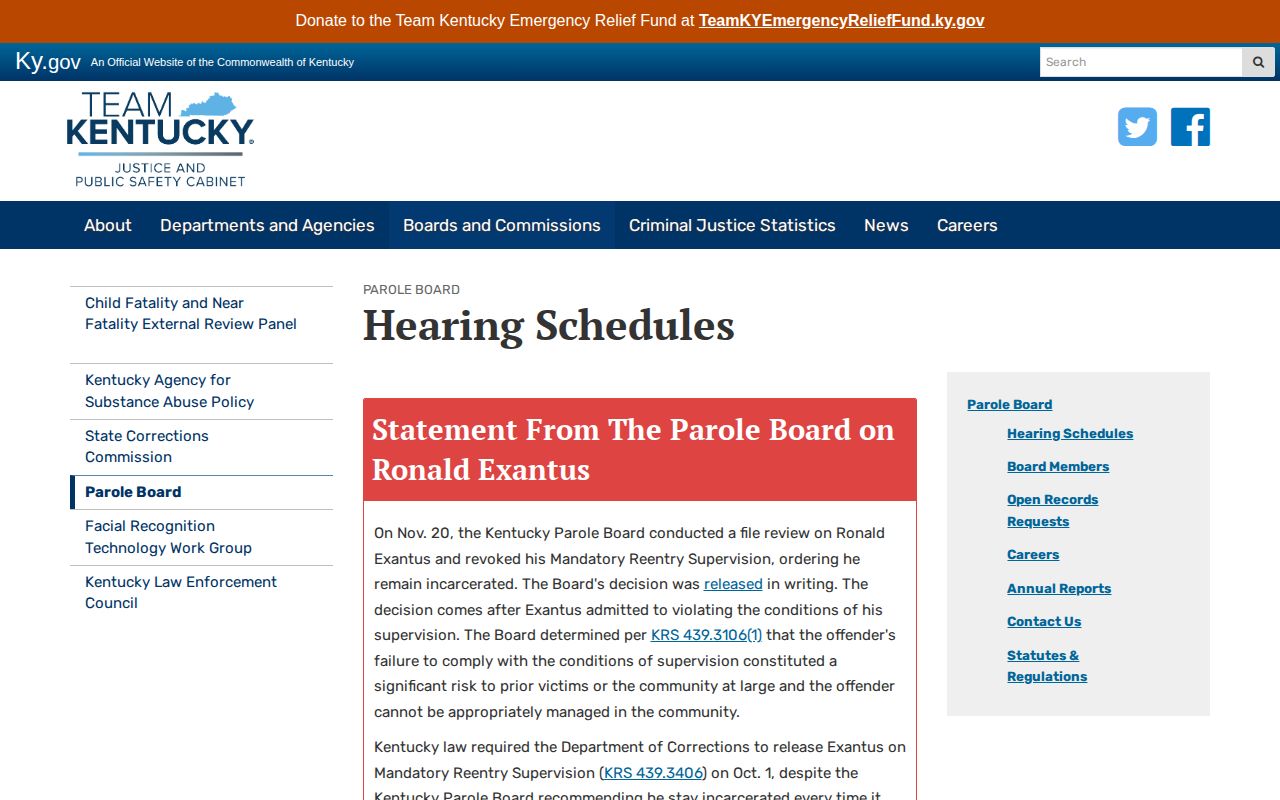
Read an eligibility list with care. It means the person may be considered. A grant may still require release planning, completion of a program, resolution of a detainer, or compliance with a Board condition. Final decisions can include grant, deferment, denial, serve-out, reconsideration, rescission, or revocation. Use the Board's exact term, then check KOOL and the Daily Releases file for the custody event.
Pulaski Supervision Agency Contacts
Pulaski County is served within Kentucky DOC Probation and Parole District 20. The official district page is the correct route for current office details and county assignments. Staff can route an appropriate inquiry, but private schedules, addresses, case plans, and confidential supervision facts are not public merely because the person appears in KOOL. Ask for public records or general routing, not personal operational details.
Kentucky supervision and records
Division of Probation and Parole, District 20
Official District 20 page
Pulaski Office of Circuit Court Clerk
50 Public Square, P.O. Box 664
Somerset, KY 42502-0664
606-677-4029
Monday through Friday, 8 a.m. to 4 p.m.
Use the Pulaski clerk's official page for the judgment, bond terms, probation order, violation filing, or later court disposition. The office routes Circuit, Family, District, and Business court records. Older files may be stored elsewhere or may have been destroyed under an authorized schedule; the clerk can provide locator information when available.
Pulaski Supervision Violations Explained
Conditions are rules attached to community supervision. A reported violation does not by itself prove a new conviction or a return to prison. The supervising agency may investigate, and a court or the Parole Board may take formal action within its authority. A warrant can lead to arrest. Revocation is the formal loss of community supervision after the required process, while rescission generally withdraws a parole action before or around release under the applicable record.
An absconder is a supervised person alleged to have stopped reporting or complying. Pulaski County has no verified official public absconder list in the research. Third-party warrant pages are not a sound substitute. Check KOOL for the current reported status and review the Pulaski docket for a filed violation or warrant. If custody changes, Kentucky VINE may issue an event notice, but the agency record remains the source for the result.
Pulaski Reentry Through CRITICAL
Somerset Community College documented a local bridge between the Pulaski County Detention Center and the community through the CRITICAL program. The reported partnership included the detention center, Goodwill Industries, the Cumberlands Workforce Development Board, and the Somerset-Pulaski Economic Development Authority. It offered guidance and practical reentry support to participants before they returned to the community.
The college's account of the CRITICAL partnership is a program record, not proof that any named person enrolled or completed it. It does show a Pulaski-specific connection between jail release planning and local support. Program participation also does not replace parole or probation terms. A person should follow the written directions from the court, Board, and supervising officer.
Pulaski Parole Eligibility Limits
Eligibility is a calculation, not a promise. Kentucky law and regulation account for offense class, offense date, sentence structure, and special statutory rules. 501 KAR 1:030 contains parole eligibility tables and special provisions. KRS 439.3401 also imposes an 85-percent rule on people who meet its violent-offender definition and the applicable term and date rules. That restriction does not apply to every person convicted of a felony.
The official regulation is also the source of the second successful page-specific manifest image.
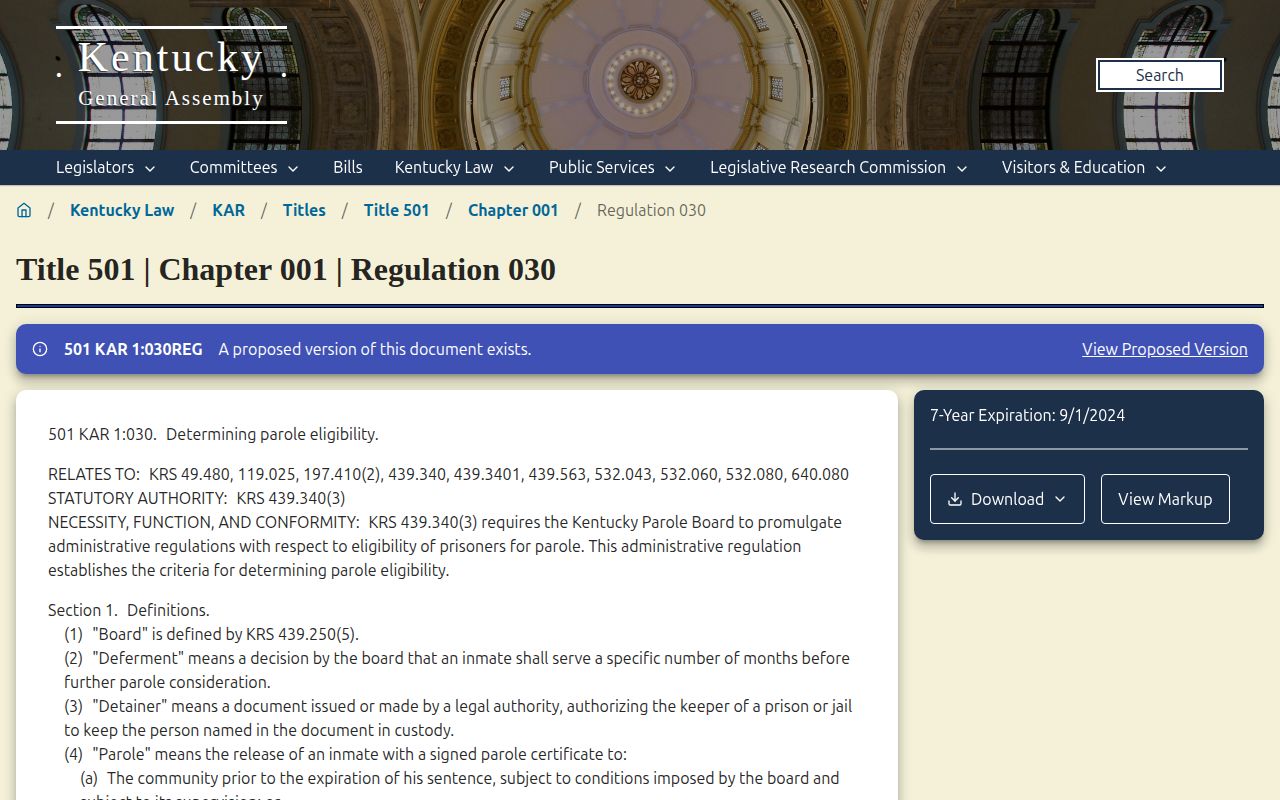
A reliable reading begins with the judgment and offense date, then applies the current statute and regulation. The Board's eligibility material may show Pulaski County Detention Center as the location for a state inmate housed locally. That does not turn the Board into a county agency. It shows why the state path still applies when a Kentucky state inmate is physically held at the Pulaski jail.
Pulaski Supervision and Final Discharge
Leaving custody and ending supervision are separate events. A parolee may leave prison while the sentence remains active. A person on probation may never have served a prison term, yet remains bound by a court order. Mandatory reentry supervision is also a release to community control. Final discharge occurs only when the sentence or supervision term ends through the proper agency or court action.
Look for an explicit discharged or sentence-completed status in KOOL and compare it with the Pulaski judgment, later court orders, or the Board record. If the status has just changed, account for the daily update cycle and the warning that newer data may not be finalized. When a copy is needed, Kentucky DOC accepts offender-record requests through its open-records process, while Pulaski court copies come through the circuit clerk. Those records provide a firmer answer than a vanished roster entry.
Kentucky DOC requests should identify the person by full name and date of birth or offender number. Requests may be emailed to correctionsopenrecords@ky.gov, mailed to the Division of Public Affairs open-records coordinator in Frankfort, or faxed to 502-564-9575. DOC publishes a five-business-day response framework under KRS 197.025. That state procedure applies to DOC records, not automatically to records held by the Pulaski jail or court clerk.